
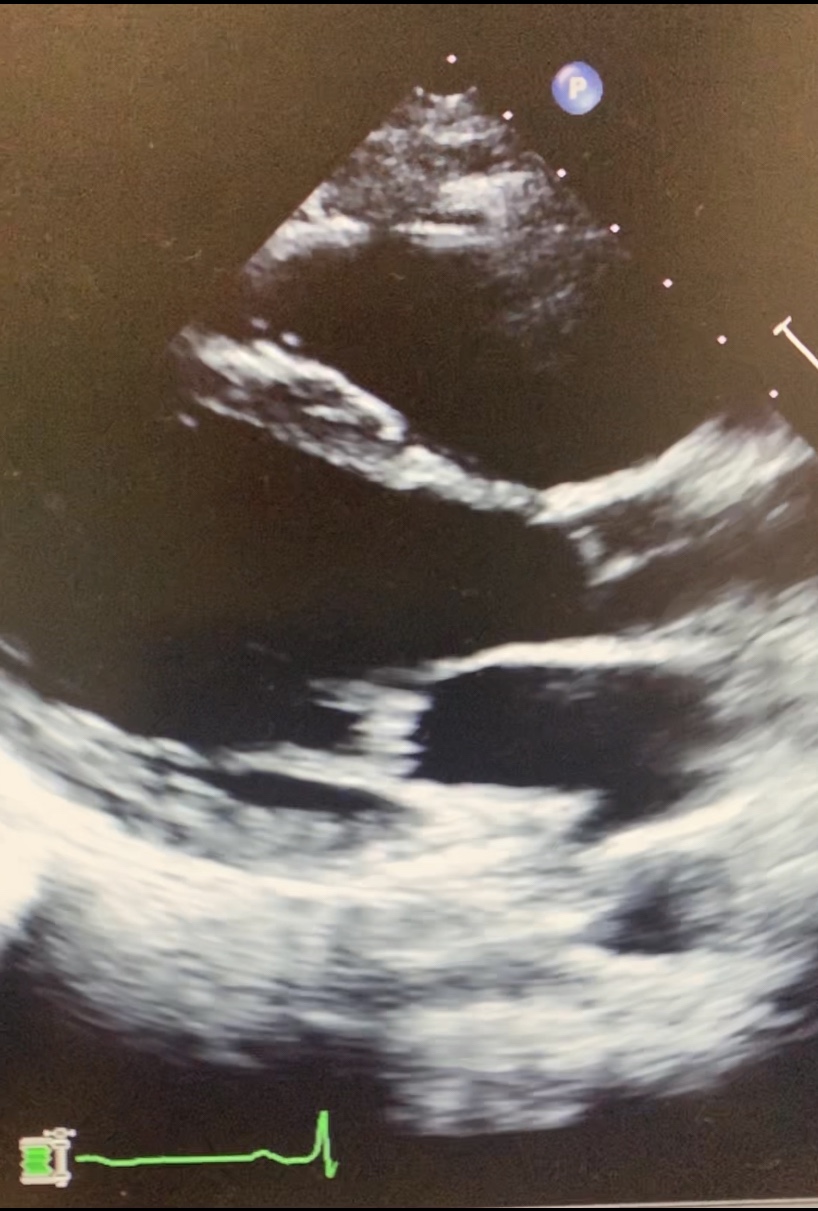
VALVULAR HEART DISEASE (VHD)
- Either acquired or congenital
- Incidence decreased due to advanced technology
- Laminar flow is smooth and its peak velocity is within the center of the flow. When normal valve is open, pressure on either side of the valve is equal w/no sig. pressure gradient (PG).
- FLOW = FLOW = FLOW think of a hose and any disruption in the flow
- Stenotic valve (obstruction) and/or regurgitant (leaky) valve create chaos.
- Stenotic valve leads to pressure overload, turbulent floaw, and hypertrophy. Creates turbulent, high velocity jets.
- Regurgitant valve leads to volume overload, turbulent flow, and dilation. Creates turbulent, high velocity jets.
- Diagnostics: 2D echo, CFD, CWD/PEDOF.
- Waves:
- TS/MS & TR/MR: jet travels toward the transducer during diastole (normal TV/MV flow); it’s narrow and turbulent with increased velocity
- TR/MR jet is turbulent and travels away from the transducer during systole, when valve is closed.
- TS/MS & TR/MR: Doppler waveform travels toward the transducer (above the baseline) during diastole (normal TV/MV flow) w/increased velocity & flatter waveform.
- TR/MR Doppler waveform travels away from the transducer (below the baseline) during systole
- AR jet is turbulent and travels toward the transducer during diastole.
- AS jet travels away from the transducer during systole (line normal AOV flow); it’s narrow and turbulent w/increased velocity.
- PR jet is turbulent and travels toward the transd. During diastole.
- PS jet travels away from the transd. During systole, it is narrow and turbulent w/incr velocity
- AR/PR Doppler waveform travels toward the trands. During diastole
- AS/PS Doppler waveform travels away from the transducer – below the baseline, during systole, w/incr. vel.
VALVULAR STENOSIS
- Is the narrowing, thickening, fusion, or blockage of valve that obstructs blood flow through the valve; 3 levels: proximal (before valve), at the level of the stenosis (at the valve) and distal (after the valve).
- Proximal: blood backs up, pressure increases: stenotic valve obstructs the flow. Pressure goes up, creates pressure overload pattern (increased afterload). Hypertrophy (thickening of walls). The greater the demand on muscle, the more it thickens and grows.
- Severe stenosis -> greater backup, greater pressure, severe hypertrophy.
- At the level: DOMING – when leaflets “round inwards” and don’t close fully. Increased pressure pushes on the undersurface of the tethered leaflets to cause doming. Thickening/fusion/calcification of the valve leaflets decreases the valve area within its orifice.
- Distal to the stenotic valve: turbulent flow, pressure decreases. (CFD more often). Mosaic pattern Doppler – red blood cells are traveling in multiple directions. Severe stenosis -> smaller area, greater velocity, more turbulent flow. REMEMBER: the atrium or ventricle has to squeeze harder to get the blood out. Decreased flow distal to the stenosis decreases the distal pressure. PG generated by the stenosis <36mmHG mild, 36-64mmHG moderate, >64 mmHg Severe.
- TTE w/Doppler
- ATRIOVENTRICULAR VALVES: MS and TS
- Pressure Half Time P1/2t- time required for the peak gradient across the valve to reduce to one-half:
- Mitral valve: MVA (cm2) = 220/PHT
- Continuity equation: SVlvot = SVmv
- ATRIOVENTRICULAR VALVES: MS and TS
LVOTarea = pi x (LVOTdiameter / 2)to the 2 power
MVA (cm2) = LVOT area x LVOT VTI / MV VTI
PISA flow rate= 2 pi r2 * Va
MVA = (PISA flow rate / Vmax) x (angle funnel/180)
Tricuspid Stenosis:
Mean Gradient Pressure >= 5mmHg
Pressure Half Time >= 180ms
Inflow VTI >60cm
Valve Area by Continuity Equation* <= 1cm2
- SEMILUNAR VALVES: AS & PS
- Peak velocity
- Aortic valve and pulmonic valve area via the continuity equation:
- AVarea = LVOTarea x LVOT VTI / AV VTI
- AVarea = [pi * (LVOTdiameter/2)2 x LVOT VTI ] / (AV VTI)
- VALVULAR REGURGITATION:
- Insufficiency – valve doesn’t close completely
- Primary: degeneration, inflammation, infection, trauma –structural changes of a valve
- Secondary: chamber remodeling eg. Enlarged ventricle
- Analogy of a door in a frame: door is the primary, frame is secondary
- Insufficiency – valve doesn’t close completely
- Doppler assessment
- In chronic insufficiency: volume overload pattern (increased preload) results in extra blood dumped into the proximal chamber. Chamber dilation.
Works Cited
Otto, Catherine: Textbook of Clinical Echocardiography
DeWitt, Suzanne: Echocardiography from a Sonographer’s Prespective: The Workbook
Both textbooks are highly recommended
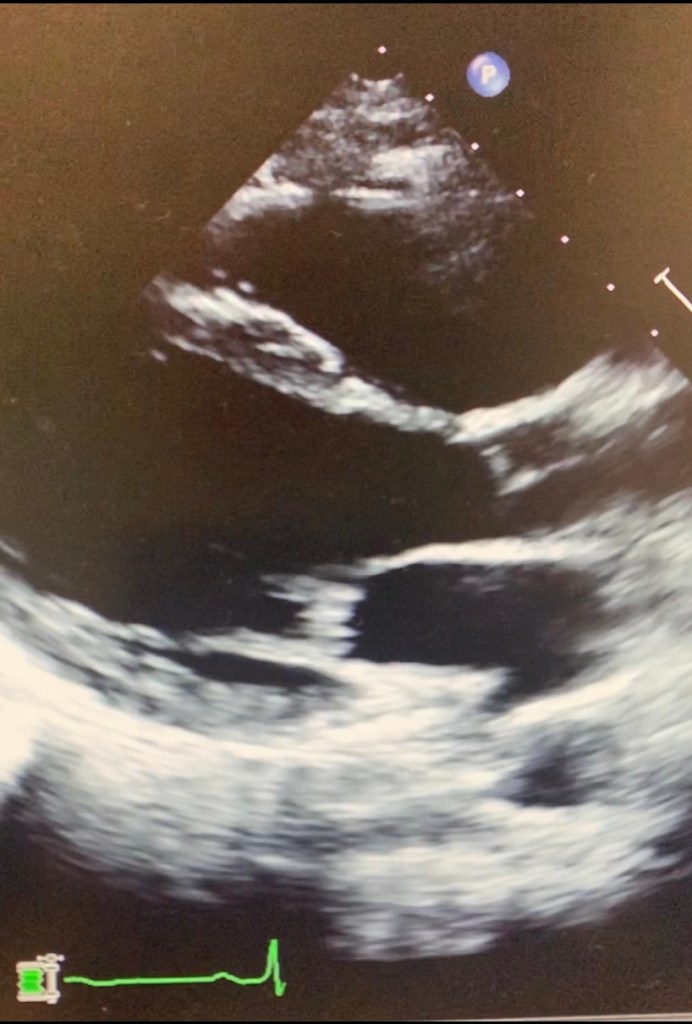

 Echo Lab and Boards Review